Reviews
4 points worth checking on advertising agencies case studies
Advertising agencies case studies should disclose the problem, baseline, team role, actions, comparison, data, economics, limitations, and transfer conditions.
What to take away
- A case study is selected evidence, often published by a party that benefits from the story.
- Separate the agency's actual contribution from client, platform, market, price, and product changes.
- Transfer the mechanism into a local test instead of copying the reported result.
Advertising agencies case studies are useful when they explain a decision and its evidence. A logo, creative reel, or percentage without a baseline and method cannot show what the agency changed or whether the effect will transfer.
Rebuild the case before judging it
| Field | Evidence to capture | Risk if missing | Worked example: Old Spice body wash, 2010, agency Wieden+Kennedy |
|---|---|---|---|
| Problem | Customer behavior, business constraint, and prior condition | The work solves an invented problem | Body wash read as an older man's product and younger buyers were not converting |
| Baseline | Exact period, unit, source, and starting result | Change has no reference point | A sales baseline exists inside Procter & Gamble; the public case does not state it |
| Role | Named agency, client, partner, and platform decisions | Credit is assigned too broadly | Wieden+Kennedy led creative; P&G brand and media teams also decided, and the split is not itemised |
| Intervention | What changed, when, where, and for whom | Several changes are treated as one | A television launch, then filmed replies to viewer questions posted within hours |
| Comparison | Control, experiment, model, prior period, or benchmark | Association is presented as causation | Prior period sales only; no holdout market was published |
| Outcome | Definition, source, maturity, and adjustments | A proxy replaces business value | Reported sales roughly doubled in the month after launch; treat that as a reported figure rather than a verified one |
| Economics | Media, fees, production, discount, margin, and capacity | Return is incomplete | Production and media spend were not disclosed, so return cannot be rebuilt |
| Limits | Missing data, outside events, uncertainty, and conflicts | Transfer looks easier than it is | Distribution gains and retail promotion ran at the same time |
Two rows decide most cases. Where the baseline is absent and the comparison is only a prior period, the file shows that two things moved together, which is weaker than proof of cause.
Use an archive as a discovery source
Effie Worldwide's effective campaign archive lets readers filter and open recognized cases across programs, years, categories, brands, and award levels. The archive supplies selected award material, not a complete market sample or an independent guarantee for another buyer.
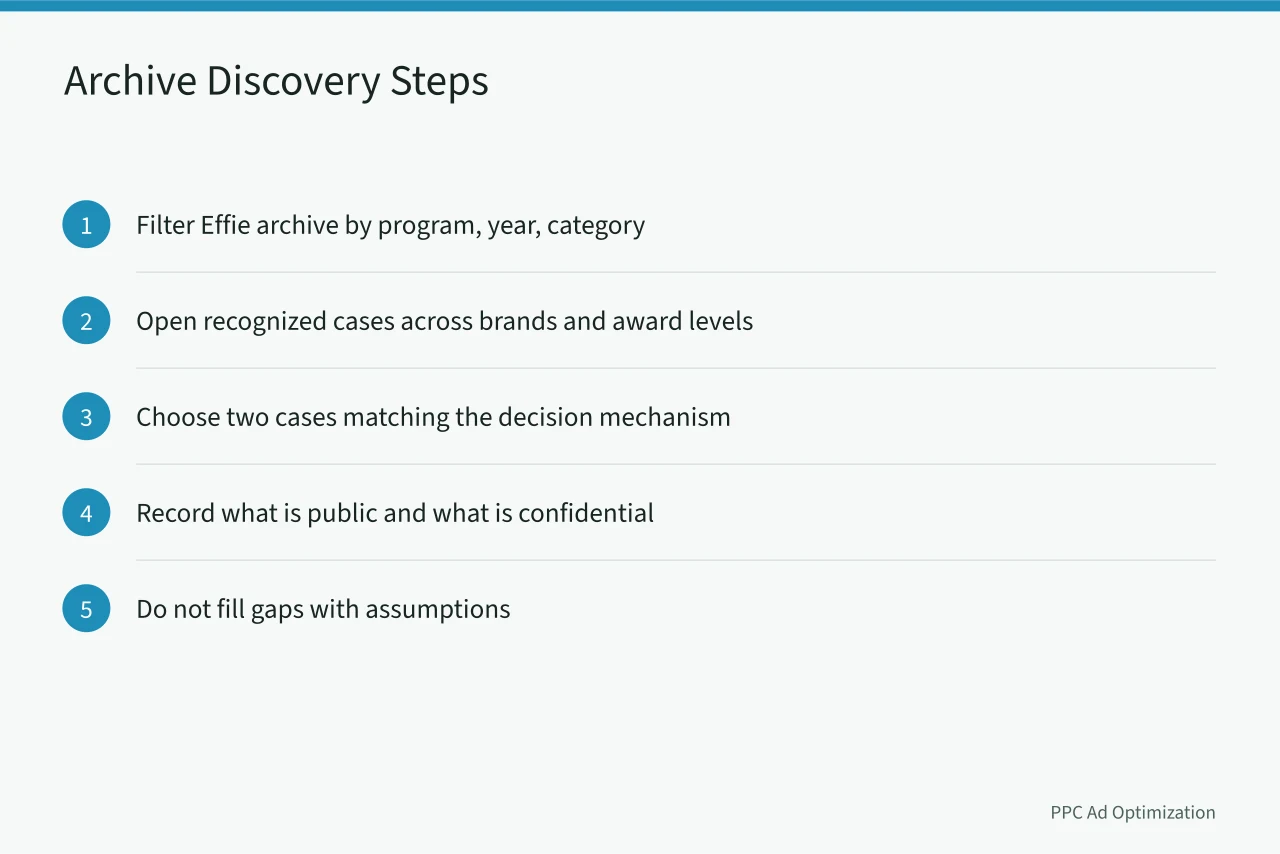
Choose two cases that match the decision mechanism, not merely the industry. One may concern demand creation, another conversion repair. Record what is visible in the public version and what remains confidential or unreported. Do not fill gaps with assumptions.
Beyond Effie, US readers can search the ANA (Association of National Advertisers) case library, the Cannes Lions winners archive, and the trade press archives at Ad Age and Adweek. In Canada, the Cassies awards archive from the Institute of Communication Agencies and Effie Canada publish effectiveness cases. Agency websites carry work too, but they are promotional.
Check how results were expected to connect
Effie Awards United States publishes entry and scoring guidelines that ask for sourced results, market context, links between objectives and outcomes, and discussion of other contributing factors. Those entry requirements help form audit questions; they do not independently verify every public case claim.
- Trace every number to its original sentence and unit
- Separate outputs, exposure, response, customer outcomes, and financial outcomes
- Name the comparison and why it is credible
- Ask what else changed during the period
- Confirm the proposed team actually did the cited work
A candid case with a limitation and correction can be more valuable than a perfect-looking win. Ask how the team handled weak creative, tracking failure, budget pressure, a wrong assumption, or an underperforming channel. The response shows judgment and operating discipline.
Check cost, ownership, and data portability
The GOV.UK technology selection guidance recommends adaptable choices, data control, security review, and ownership-cost analysis. Apply the same four questions to a US or Canadian agency proposal: who owns the creative files and the media accounts, how long the licence runs, what audience data leaves with you, and what an exit costs.
The GOV.UK open standards guidance links open standards with interoperability and reduced supplier dependence. In this market, check that campaign reporting, audience definitions, and naming conventions can move to another vendor without being rebuilt from scratch.
For advertising agencies case studies, keep the evidence record beside the decision so a reviewer can reproduce the reasoning without relying on memory. Set the next review date for advertising agencies case studies and name the change that would trigger an earlier check.
Common questions
Can a confidential case be trusted?
It can inform a conversation, but verify what the client permits, obtain references where possible, and do not score unsupported numbers as confirmed evidence.
Should case results become agency guarantees?
No. Markets, offers, teams, timing, and measurement differ, so a result won for one advertiser cannot be promised to another.
How recent should a case be?
Recent work helps with current systems and teams, while older work may still show durable judgment. Record what has changed since it ran.