Costs
Part of What a Campaign Brief Template Must Contain
Which Campaign Brief Template Case Studies Help
Named campaign brief template case studies for 2027, with the planning questions each one contributes and the limits of what a case can prove.
What to take away
- Five named cases carry this roundupGCS RESIST 3, Swindon Borough Council's voter ID work, the OASIS planning model, the Behavioural Insights Team's EAST framework, and CDC's Tips From Former Smokers.
- None of them proves a brief template caused an outcome; each supplies questions your own brief should ask.
- RESIST 3 is the only one built for information threats, so its fields belong in a rapid-response brief, not a product launch.
- Swindon shows inclusion as an operational input, not a final creative review.
- EAST turns the requested action into four checkseasy, attractive, social, timely.
- Tips shows how testimonials get sourced, tested and disclosed.
- Every transferred field needs a source link, an owner, and a review date before it enters a live brief.
A campaign brief template case study roundup earns its place by naming the cases and saying what each one contributes. This article covers five, all reviewed in September 2026.
All five come from publicly funded programs, which publish planning material and results more often than commercial brands do. Their planning questions transfer to commercial campaigns more reliably than their outcomes do.
Case 1: RESIST 3, for information threats
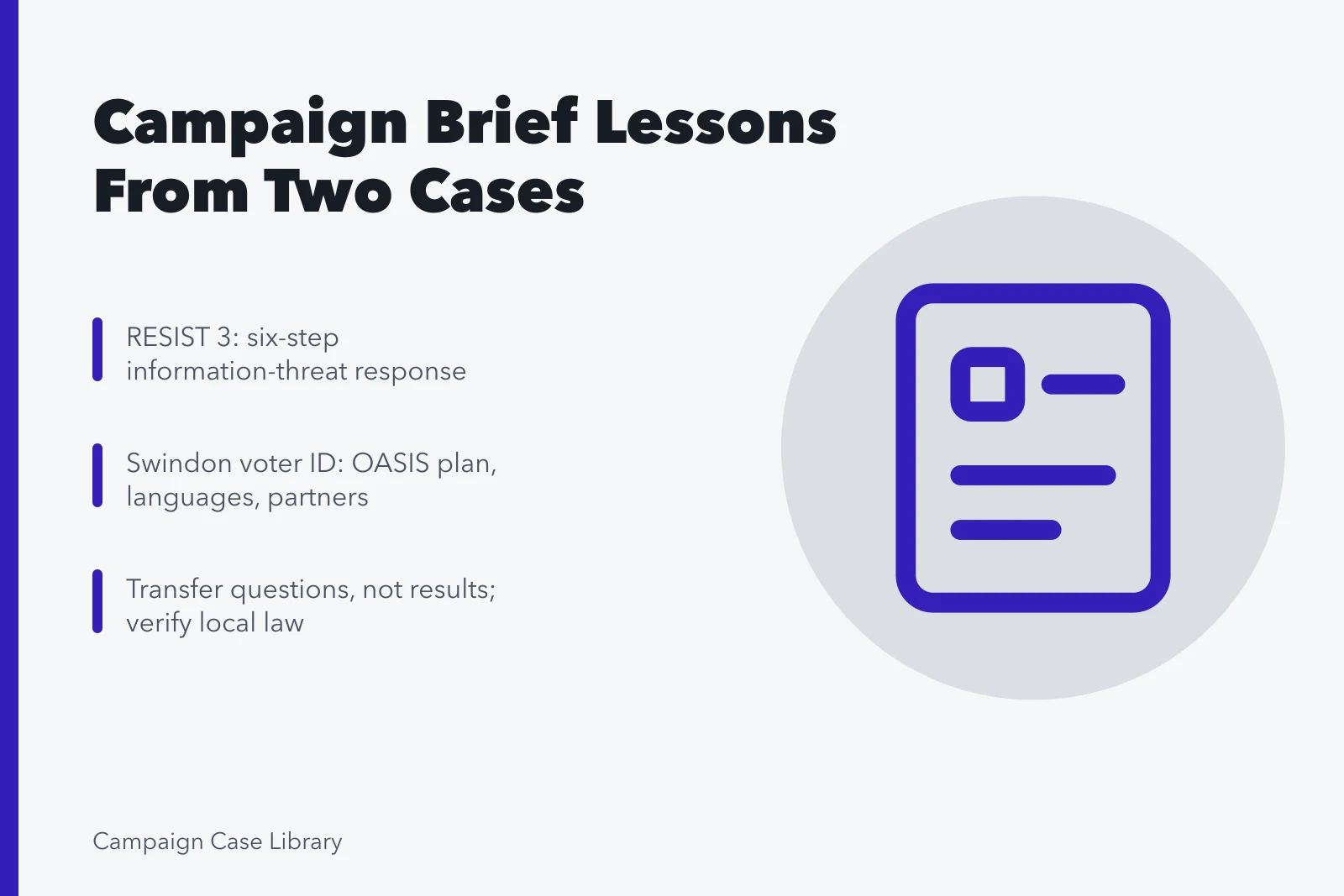
The Government Communication Service published RESIST 3 as a framework for building resilience to information threats. It sets out six stages:
RESIST 3, for information threats
- recognition
- early warning
- situational insight
- impact analysis
- strategic communications
- effectiveness tracking
It is a conceptual government framework, not evidence that any single response works.
A rapid-response brief built on it needs a verified objective, a named source authority, an approval path, and a monitoring boundary. It also carries fields a launch brief drops, which is where campaign brief template sections diverge most between brief types.
Case 2: Swindon Borough Council, for audience access
The Local Government Association published the Swindon voter ID case study, covering a voter-information campaign run under new identification requirements.
Photo ID became mandatory at polling stations in England under the Elections Act 2022, first enforced at the May 2023 local elections. Swindon's documented plan included diversity-impact work, trusted community routes, accessible languages, leader briefing, and crisis preparation.
The transferable lesson is that access is an operational input. Audience evidence, service routes, partner roles and evaluation get decided before creative, not after. The case reports results in one local setting, so treat those numbers as context rather than a forecast.
Case 3: OASIS, the planning model underneath
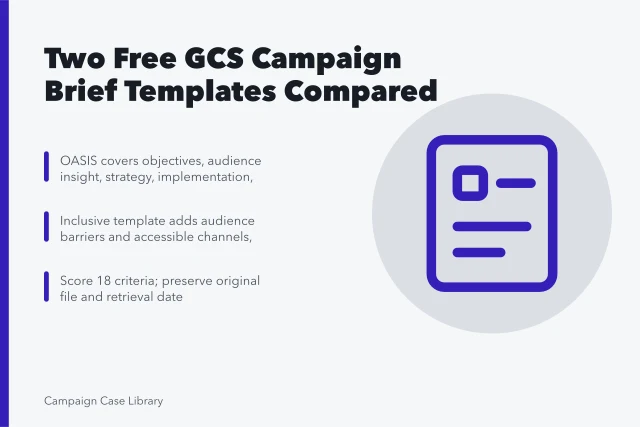
OASIS is the UK government communication planning model: objectives, audience insight, strategy, implementation, and scoring. Swindon's plan was built on it, which makes it the third case here and the one most directly reusable. It is a planning sequence, not a template file, so you adopt its order of decisions rather than its layout.
OASIS forces audience insight ahead of strategy. Most commercial briefs reverse that, writing the strategy first and backfilling the audience. If your brief has a strategy section that no evidence section feeds, OASIS is the case to study. How to create campaign brief templates covers the fields every version needs.
Case 4: EAST, for the behavioral ask
The Behavioural Insights Team, which began inside the UK Cabinet Office in 2010, published EAST in 2014. The framework reduces a behavior change brief to four checks: make the action easy, attractive, social, and timely.
The value sits at field level. Ask whether the requested action takes one step or five, whether the reward is visible now, whether other people are seen doing it, and whether the moment is right. A brief that answers those four can define its ask instead of promising general awareness.
Case 5: Tips From Former Smokers, for message proof
The Centers for Disease Control and Prevention launched Tips From Former Smokers in 2012. The campaign uses real former smokers rather than actors, and CDC publishes its evaluation reports and campaign materials.
Tips documents how testimonials were sourced, tested with the audience, and cleared for health claims before broadcast. If your template has a testimonials field with no sourcing rule and no disclosure line, this case supplies both.
The transfer test
Reusable question
- RESIST 3
- Who recognizes, assesses, authorizes, responds, and learns?
- Swindon voter ID
- Which audiences, barriers, routes, partners, and services matter?
- OASIS
- Does audience insight come before strategy?
- EAST
- Is the action easy, attractive, social, and timely?
- Tips From Former Smokers
- How are testimonials sourced, tested, cleared, and disclosed?
- New campaign
- What local evidence and authority support adaptation?
Boundary
- RESIST 3
- Framework, not outcome proof
- Swindon voter ID
- One local public case
- OASIS
- Planning order, not a file
- EAST
- Behavior checklist, not a channel plan
- Tips From Former Smokers
- One national public health campaign
- New campaign
- Must be tested again
Audit the evidence before you cite it
The FTC advertising substantiation policy requires a reasonable basis for objective advertising claims before they are disseminated. That applies to any performance number you lift from a case study into a pitch.
The FTC guidance for marketers using reviews covers fake feedback, selective requests, conditioned incentives, hidden relationships, and paid rankings. Apply the same tests when a roundup names providers.
Keep the evidence record beside the decision so a reviewer can reproduce the reasoning. Set the next review date and name the change that would trigger an earlier check. A campaign brief template checklist is where you record who accepted each transferred question.
Common questions
Do these cases prove a template works?
No. They document planning and implementation in specific settings. This article extracts questions without assigning causal credit to a form or predicting a new result.
Why include public-sector cases?
They publish their planning material, their evidence and their results, which commercial case studies often do not. The questions adapt; the outcomes do not.
What has to be checked before reuse?
The objective, the jurisdiction, the audience evidence and the service capacity. Then the access needs, the partner roles, the platform conditions and the evaluation method.
Where does a transferred field belong?
In the brief section that owns the decision, with a source link and a named owner. A field with no owner is a field nobody fills in.