Operations
Part of What a Campaign Brief Template Must Contain
What a Campaign Brief Template Checklist Covers
campaign brief template checklist for 2027 tests the problem, objective, audience, proposition, delivery, budget, safeguards, measurement, approvals, and release.
What to take away
- Mark a check ready only when its evidence, definition, owner, limitation, and approval are visible.
- Test the audience, proposition, delivery, money, safeguards, measurement, and release, not the number of completed boxes.
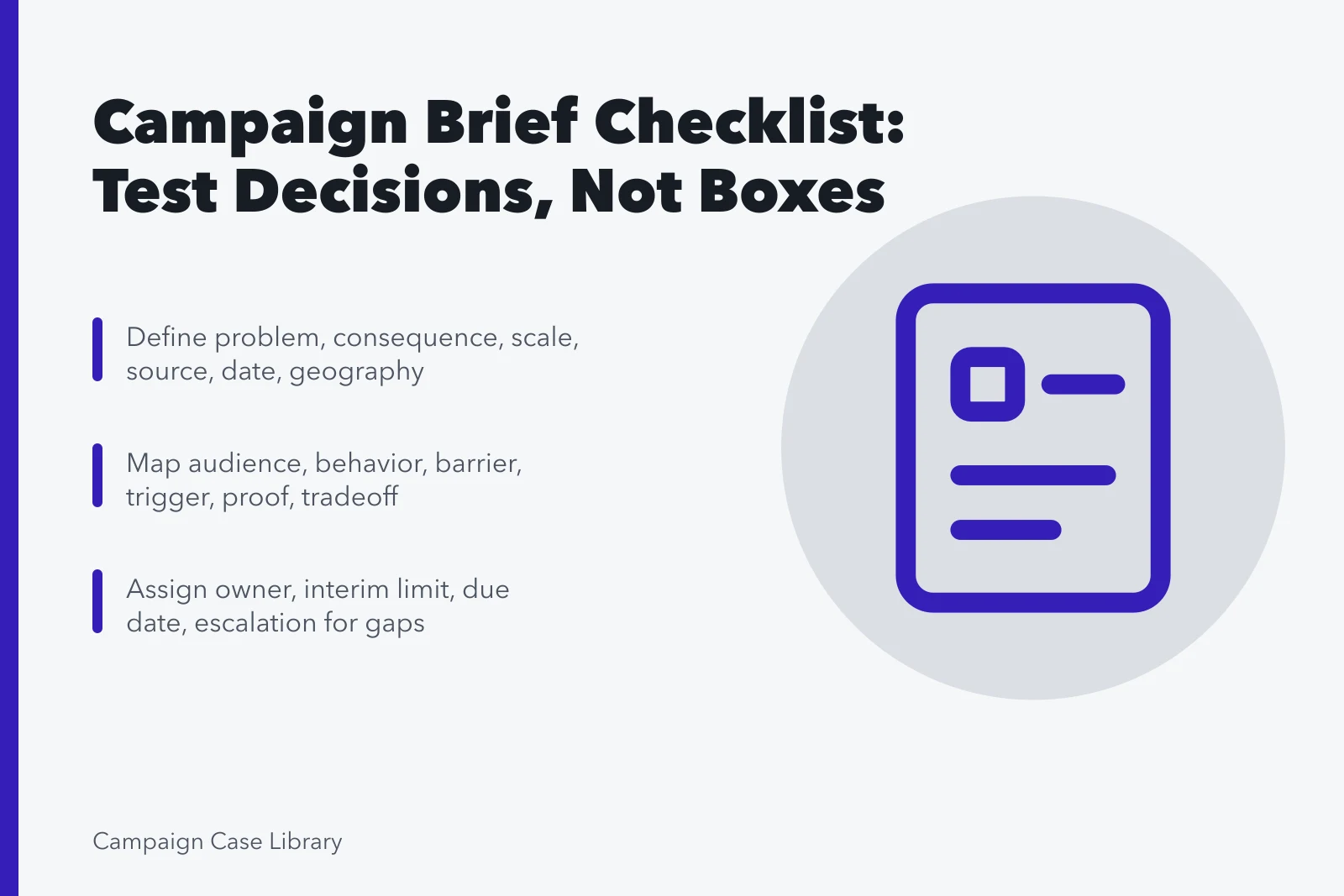
- Give every unresolved item an owner, interim limit, due date, escalation path, and consequence for release.
A campaign brief template checklist should expose missing decisions, not reward completed boxes. Adapt every check to the campaign's markets, rules, spend, audience, and risk.
Problem and objective
The U.S. Small Business Administration's marketing and sales guide asks businesses to identify a target market, competitive advantage, goals, actions, a marketing budget, and a process for comparing costs with results. Use these as planning checks, not proof that a campaign choice will work.
- Define the observed problem, consequence, scale, source, date, geography, current response, and uncertainty.
- Connect the assignment to an organizational outcome and state communication's plausible contribution.
- Give each objective an audience, baseline, target, time frame, method, and attribution limit.
Audience and proposition
- Map primary, secondary, influencing, gatekeeping, partner, staff, and affected non-target groups.
- Describe current behavior, journey, barrier, trigger, need, research source, confidence, and disconfirming evidence.
- State desired response, service path, proposition, proof, tradeoff, message hierarchy, disclosures, and claim limits.
Strategy and delivery
Campaign brief template sections differ most in how much they leave open, so check these against the template you have.
- Separate fixed constraints from strategic choices the responding team must make and justify.
- Assign channel roles across discovery, evaluation, action, service, retention, and feedback.
- List deliverables, formats, variants, accessibility needs, source files, scope, exclusions, and change rules.
- Build dated research, approval, production, localization, trafficking, launch, and evaluation dependencies.
Money, people, and safeguards
The Federal Trade Commission's advertising FAQ for small business explains that U.S. advertising must be truthful, nondeceptive, evidence-based when appropriate, and clear about material disclosures. Route actual claims through qualified review in every market and keep the evidence behind the approved wording.
- State the budget and whether media, production, research, rights, technology, tax, contingency, and evaluation are included.
- Name owners, reviewers, approvers, supplier contacts, decision rights, escalation, and stop authority.
- Check privacy, consent, data access, rights, regulated claims, inclusion, fraud imitation, capacity, and unintended effects.
Evaluation and release
- Map indicators to definitions, sources, frequency, analysis, owners, decision rules, and reporting dates.
- Specify response format, cost structure, assumptions, references, selection criteria, and question process.
- Approve a numbered version, preserve linked evidence, record changes, and notify every recipient.
Finish with a read-back test. Where a reader cannot find the approver, the campaign brief template design tips are the fix, not more fields. An uninvolved person should explain the assignment, audience, desired change, open decisions, deliverables, budget boundary, dates, approver, and success measure without filling gaps from experience.
Repeat it after material changes to objective, audience, evidence, budget, schedule, claims, data, or regulation. An approved brief can become misleading when conditions change, and it returns to the approver.
Checklist disposition record
| Status | Required record | Next action |
|---|---|---|
| Ready | Evidence, owner, limit, approval | Release with version |
| Conditional | Gap, interim control, deadline | Assign and monitor |
| Not ready | Material unsupported decision | Stop or redesign |
| Not applicable | Reason and approver | Recheck after scope change |
Record the gate result
The W3C Privacy Principles statement gives web-system designers shared privacy concepts and warns against shifting privacy work to individuals. Apply it to the checklist, then review the governing law and configuration.
The CISA software acquisition fact sheet covers development practice, supply-chain exposure, deployment, and vulnerability management. Add those questions to a checklist review without treating them as approval. The campaign brief template examples show which checks a published brief already answers.
Common questions
Should every checklist item be mandatory?
No. Mark a genuinely irrelevant item not applicable, record the reason, and name who accepted it.
What happens when evidence is incomplete?
Record the uncertainty, interim limit, test, owner, deadline, and decision it blocks. Never convert an unknown into a pass.
Who signs off the checklist?
Use the accountable campaign owner, supported by reviewers for evidence, operations, budget, accessibility, privacy, rights, and claims.