Reviews
Part of What a Campaign Brief Template Must Contain
How Campaign Brief Template Sections Differ
campaign brief template sections organize seven connected modules for context, objectives, audiences, strategy, governance, safeguards, evaluation, and learning.
What to take away
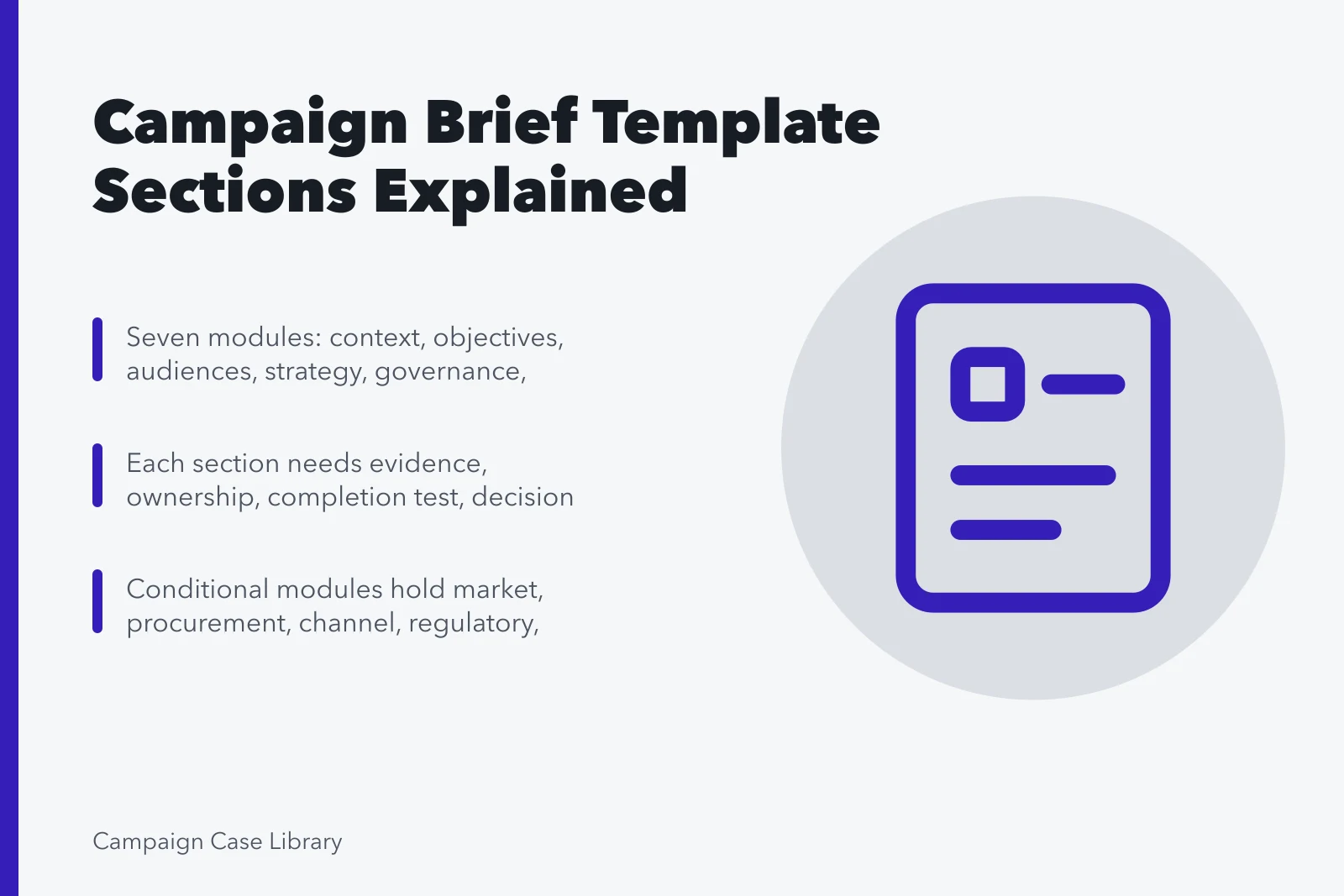
- Seven sections take the reader from controlled context to an objective, audience choice, response, delivery, safeguards, and evaluation.
- Every section needs evidence, ownership, a completion test, and a clear link to the campaign decision.
- Keep the stable core concise and place market, procurement, channel, regulatory, rights, and risk fields in conditional modules.
Campaign brief template sections should take a team from a defined problem to a measurable assignment. Keep a stable core for comparison, then add conditional modules for market, channel, procurement, regulation, rights, and risk.
Control and context
Record brief identifier, owner, approver, version, status, approval date, deadline, and linked evidence. Summarize the organization, offer, market, prior activity, and the reason the assignment exists now.
Problem and objective
The UK government's communications functional standard sets a campaign lifecycle that moves through objective, audience insight, implementation, and evaluation. Use those stages to test whether the brief connects its problem to action and learning, applying only the standards that govern the organization.
Define the observed problem, scale, source, current response, consequence, and uncertainty. State the organizational outcome and the communication objective with audience, baseline, target, time frame, method, and attribution limit. That outcome is set above the campaign, where marketing strategy templates fix the market and audience choices a brief inherits.
Audience and insight
Identify primary, secondary, influencing, gatekeeping, partner, staff, and affected non-target groups. Describe current behavior, journey, barrier, trigger, need, research source, limitation, and the evidence that would change the working insight.
Response, proposition, and messages
State what the audience should understand, decide, or do, plus the service path. Define value, proof, tradeoff, claim limits, primary and supporting messages, call to action, disclosures, and localization needs.
Strategy and implementation
Set the strategic questions still open, channel roles, partnerships, tests, deliverables, formats, variants, schedule, dependencies, budget, scope, and exclusions. Mark fixed requirements separately from open choices.
Governance, safeguards, and response
Name decision rights, review stages, accessibility needs, privacy constraints, usage rights, claims review, risks, stop conditions, and change control. Specify the proposal structure, cost breakdown, team, assumptions, references, and selection criteria.
Evaluation and learning
The Government Communication Service Evaluation Cycle separates inputs, outputs, outtakes, outcomes, organizational impact, and learning. Give each layer a definition, baseline, source, owner, timing, limitation, and decision rule instead of copying every measure into every campaign.
Separate delivery, audience response, behavior, and organizational impact. Plan evaluation at the beginning, not after launch. The same layering appears a level up, where marketing plan template sections carry the annual view.
Keep the visible brief concise, but do not delete evidence or control fields to meet a page count. Link supporting files through stable identifiers and test whether an uninvolved reader can explain the assignment. If that reader fills gaps with assumptions, repair the prompt before release. Review conditional modules so the stable core remains coherent.
Seven-section acceptance map
| Section group | Required output | Acceptance question |
|---|---|---|
| Control and problem | Identity, evidence, consequence, objective | Is the assignment specific? |
| Audience and response | Behavior, insight, proposition, message | Does evidence support the choice? |
| Delivery and safeguards | Strategy, scope, money, roles, risks | Can the team execute safely? |
| Evaluation and learning | Definitions, sources, rules, review | Will evidence change a decision? |
Resolve the question with a decision record
The GAO evaluation design guide connects evaluation questions with evidence needs and design choices. Apply that discipline here; federal evaluation guidance does not make a local marketing result causal or transferable.
The W3C Privacy Principles statement gives web-system designers shared privacy concepts and warns against shifting privacy work to individuals. Apply it to these sections, then review the governing law and configuration. Turning all seven into a working file is the subject of how to create campaign brief templates.
Common questions
Must all seven sections have equal length?
No. Give more space to the evidence, choices, operating limits, and risks. Keep identity and control fields concise.
Can supporting evidence live elsewhere?
Yes. Use a stable identifier, owner, version, retrieval date, and approved snapshot so a reviewer can trace it.
What belongs in a conditional module?
Use one for a genuine change in market, channel, procurement, regulation, rights, data, or risk, not for decorative customization.