Careers
Part of What a Campaign Brief Template Must Contain
Which Campaign Brief Template Examples to Copy
Six campaign brief template examples you can copy today, covering B2B launches, local demand, retention, market entry, creator work, and public information.
What to take away
- Six copyable briefs follow: B2B launch, local demand, retention, market entry, creator partnership, and public information.
- Each one names a real template to copy, from HubSpot, Smartsheet, Asana, Notion, Miro, or Canva.
- Every brief keeps one spine (objective, audience, proposition, measure, governance) and swaps only the modules the assignment needs.
- Copy the field list, not the sample values. Audience, cost, and target lines are placeholders until local evidence replaces them.
- Creator briefs need disclosure, usage rights, and substantiation fields before any content is commissioned.
- Date every brief and log its version, so a reused brief never carries a stale claim into a live campaign.
A campaign brief is a decision record, not a form. The six campaign brief template examples below are copyable field lists, and each one is paired with a named template you can open today. Swap the sample values for your own evidence.
Every example names the sections to keep, the modules to add, and the lines to delete. Start from the campaign brief structure, then pick the closest example.
Example 1: B2B product launch, from Asana's campaign brief
Asana keeps a free campaign brief template in its template library; adding it to a project fills goals, audience, messaging, channels, and dates. HubSpot publishes free marketing plan templates in the same shape for teams that want an editable document. Keep the spine in either one.
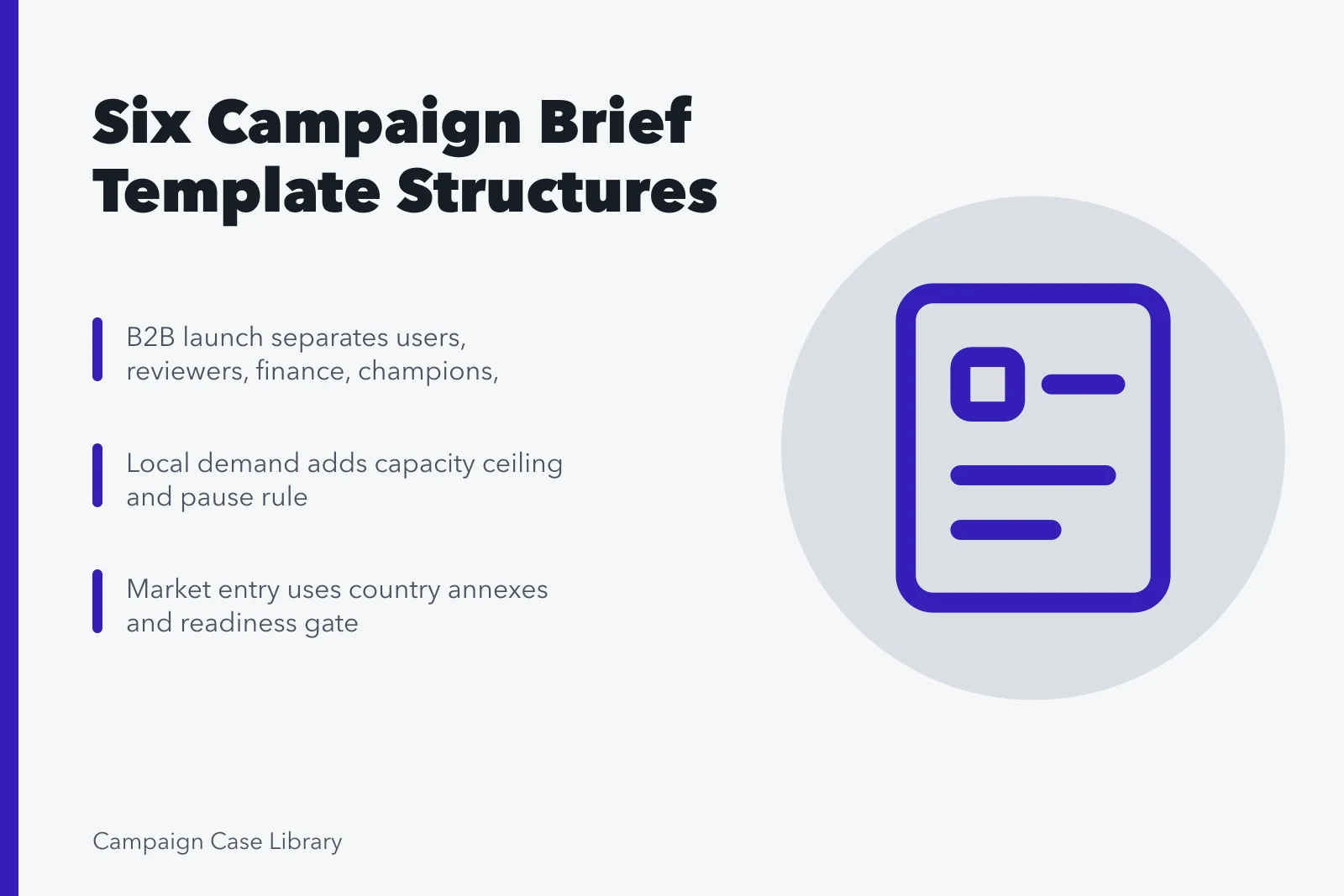
Add buying-role fields: user, technical reviewer, finance approver, internal champion, final signer. Add proof required per role, demo capacity, named account list, and the qualified-pipeline definition.
Delete consumer-style reach targets. A launch brief that measures impressions tells the sales team nothing about handoff readiness.
Example 2: Local service demand, with Smartsheet's free brief
Smartsheet offers free campaign brief templates as downloadable files, usually in Word and PDF, so a single-site operator can edit one without buying software. Add service area, seasonal capacity ceiling, booking path, response-time commitment, and a pause rule that stops promotion when bookings exceed capacity.
Measure inquiries, qualified bookings, completed jobs, contribution, and repeat use as separate lines. One blended conversion number hides the leak. The campaign brief template sections page lists which fields belong to which module.
Example 3: Customer retention, with Airtable and the OASIS model
Airtable's template gallery includes campaign briefs that hold a cohort as a linked table, which suits retention tests and their follow-up dates. The UK Government Communication Service publishes OASIS, a free planning model covering objectives, audience insight, strategy, implementation, and scoring. Both are copyable.
Add cohort definition, the single cancellation barrier being tested, and contact permissions. Also add offer economics, support capacity, and the cancellation outcome.
The Government Communication Service's behavior-change principles break behavior into capability, opportunity, and motivation, with planned evaluation. Borrow that diagnosis. The source does not describe or validate this example.
Put operational dependencies above channel activity. A discount cannot fix a billing error.
Example 4: International market entry, with Notion's template gallery
Notion's template gallery carries campaign planning pages you can duplicate into a free workspace, and each sub-page can act as a country annex. Keep one core brief for objective, proposition, measurement, and governance. Add a country annex per market.
Include the language, channels, price, and service path. Also include the claims review, data handling, partners, and local approver.
Add a readiness gate. Translation and media buying wait until the offer and the operating path are signed off.
Example 5: Creator partnership, with Canva and Miro
Canva's free plan includes creative brief templates you can share with a creator. Miro's campaign brief board works better when the terms need review in one place, and Miro's free plan allows three editable boards.
Add audience fit, creative freedom, disclosure, usage rights:
- category conflicts
- safety
- approval
- platform access
- fraud checks
- compensation
- performance definitions
The FTC's social-media disclosure guide covers material connections and clear disclosure for endorsers and advertisers under U.S. law. Confirm the rules for each market you buy in with a qualified lawyer.
Separate the creator's documented claim from your own substantiation duty, and name an escalation contact. Few free campaign brief templates carry controls this specific, which is the first thing to check.
Example 6: Public information, with OASIS and the CDC index
Keep the OASIS brief and add service eligibility, accessible alternatives, affected non-target audiences, and misinformation response. Also add procurement rules and operational capacity. The CDC's Clear Communication Index scores a draft leaflet or page against plain-language criteria before release.
Keep four measurement lines apart: outputs, audience response, behavior, and organizational impact. Merging them lets a leaflet count stand in for a behavior change.
The six briefs and where to copy them
| Example | Distinct decision | Extra control | Where to copy it |
|---|---|---|---|
| B2B launch | Buying roles | Sales handoff | Asana campaign brief; HubSpot marketing plan templates |
| Local demand | Service-area demand | Capacity pause | Smartsheet campaign brief template |
| Retention | Cancellation barrier | Experiment design | Airtable campaign brief; GCS OASIS |
| Market entry | Market readiness | Country gate | Notion campaign planning template |
| Creator | Endorsement terms | Disclosure and rights | Canva creative brief; Miro campaign brief board |
| Public information | Public action | Service access | GCS OASIS; CDC Clear Communication Index |
Check before you reuse
The GAO data reliability guide treats reliability as fitness for an intended use and requires a documented assessment. Run that test on any figure you carry into a new brief.
The FTC advertising substantiation policy requires a reasonable basis before objective claims go out. Apply it to every performance line in the brief. The marketing plan templates face the same test one level up.
Common questions
Are these briefs based on real campaigns?
No. They are constructed field lists with no client result, measured performance, or forecast attached. Copy the structure, then fill it with your own evidence.
Can one template cover all six?
Yes, if the spine stays fixed and the modules stay optional. The differences live in evidence, roles, controls, and risk, not in the base fields.
Which one should a team start with?
Start with the brief whose distinct decision matches yours, delete the fields you cannot fill, and add the requirements your market, channel, and risk profile demand.
How often should a brief be re-dated?
Every time it is reused. A brief carrying last year's audience assumption or price line is a claim waiting to be published.