Strategy
Part of What a Campaign Brief Template Must Contain
How Campaign Brief Template Software Compares
campaign brief template software for 2027 compares Microsoft Word and Asana by brief authoring, workflow, evidence, permissions, accessibility, export, and control.
What to take away
- This unpaid, nonranking comparison covers Microsoft Word for narrative authoring and Asana for intake connected to campaign execution.
- Vendor-documented features are not evidence of fit, so test the organization's exact plan, storage, permissions, accessibility, exports, and external access.
- Keep a portable approved snapshot and exit process so a brief remains usable when a plan, feature, account, integration, or supplier changes.
Campaign brief template software should fit the work around the brief, not force the brief into a fashionable interface. This unpaid, nonranking comparison uses vendor documentation checked in September 2026. Features, plans, security, data handling, integrations, and pricing can change before 2027, so verify them directly.
Microsoft Word
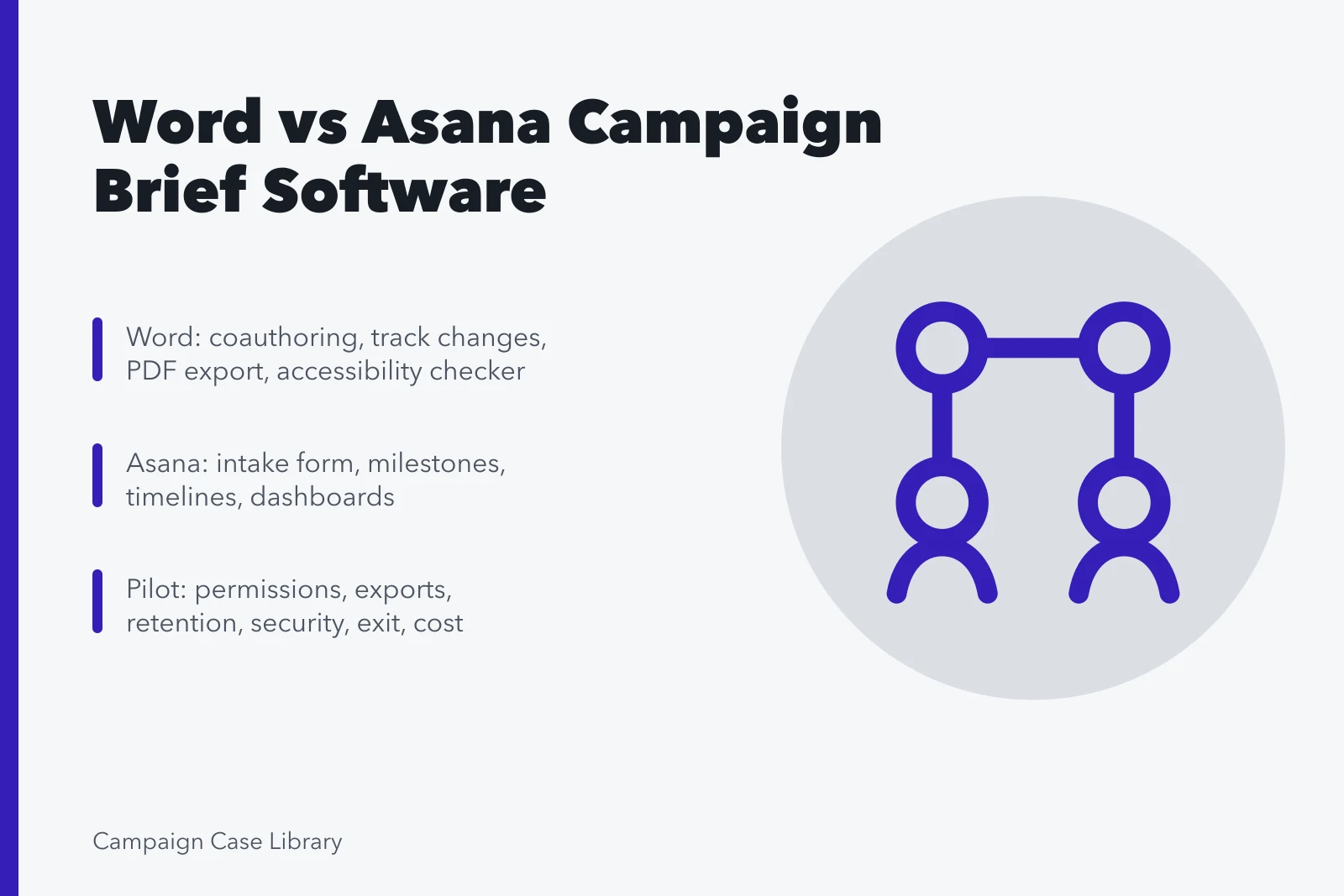
Microsoft's Word web-and-desktop feature comparison lists real-time coauthoring, track changes, version history, PDF export, and an accessibility checker for the compared editions. Verify the current edition and supported storage because the page documents features, not permissions or practical fit.
Word can suit a controlled narrative brief and portable source file when the organization needs detailed writing, review, and a released snapshot. Confirm the exact edition, storage, permissions, history, fonts, fields, macros, accessibility, and export behavior instead of assuming every Word environment behaves alike.
Asana
Asana's campaign-management template page describes an intake form for goals, target markets, and supporting material, plus milestones, timelines, responsibilities, views, and dashboards. The vendor page may change, so test the current plan before the pilot.
Asana suits teams that connect campaign intake to milestones, tasks, timelines, responsibilities, and status. Check whether its narrative depth, evidence record, formal approvals, permissions, exports, accessibility, retention, and guest access meet the requirement on the selected plan.
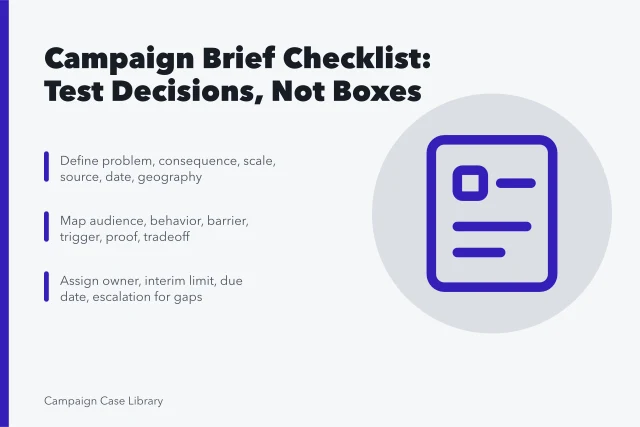
A campaign brief template checklist turns those intake fields, objective through budget, into a pass or fail test before a brief moves to execution.
Run a scored pilot
Test authoring, review, approval, evidence links, conditional fields; use one representative campaign and one real external collaborator.
User permissions, version recovery, search, export, accessibility; separate vendor-documented capability from what the pilot actually observes.
Retention, integration, residency, security review, support; keep a portable approved copy and exit process so the brief remains usable if the tool, plan, integration, or supplier changes. Total cost.
If external agencies need access, test guest onboarding, offboarding, confidentiality controls, notifications, mobile use, and export before selection. Ask procurement, security, privacy, accessibility, records, and legal reviewers to assess the areas they own under applicable policy. Those same campaign brief template design tips call for showing status and version where a reviewer can find them right away. Retest annually.
Two-tool pilot scorecard
Two-Tool Pilot Scorecard
Microsoft Word
- Potential strength
- Narrative source and review
- Proof needed in pilot
- Permissions, history, accessibility, export
Asana
- Potential strength
- Intake connected to execution
- Proof needed in pilot
- Narrative, approval, guests, retention
Either
- Potential strength
- Reusable controlled workflow
- Proof needed in pilot
- Security, cost, exit, approved snapshot
Potential strength
- Microsoft Word
- Narrative source and review
- Asana
- Intake connected to execution
- Either
- Reusable controlled workflow
Proof needed in the pilot
- Microsoft Word
- Permissions, history, accessibility, export
- Asana
- Narrative, approval, guests, retention
- Either
- Security, cost, exit, approved snapshot
Test the operating burden
The GOV.UK technology selection guidance recommends adaptable choices, data control, security review, and ownership-cost analysis. Use those public-service questions when assessing campaign brief template software; they are not product endorsements.
The GOV.UK open standards guidance links open standards with interoperability and reduced supplier dependence. Test whether campaign brief template software data can move, noting the UK public-service context.
For campaign brief template software, keep the evidence record beside the decision so a reviewer can reproduce the reasoning. Set the next review date and name the change that would trigger an earlier check.
Common questions
Is one tool ranked above the other?
No. This unpaid comparison covers different working models. Select only after a scored pilot against the organization's content, control, access, risk, and export needs.
Can a team use both tools?
Yes. Define which system holds the authoritative brief, how approved fields move into execution, who owns each record, and how contradictions are resolved.
What should a pilot include?
Use one representative campaign and outside collaborator to test authoring, review, approval, evidence, permissions, recovery, search, accessibility, export, retention, support, cost, and exit.