Strategy
Part of No Shortcuts Here: Marketing Report Is Decided by the Basics
Getting Marketing Report Template Sections Right the First Time
marketing report template sections organize seven decision-ready modules for control, definitions, objectives, economics, findings, actions, limits, and evidence.
What to take away
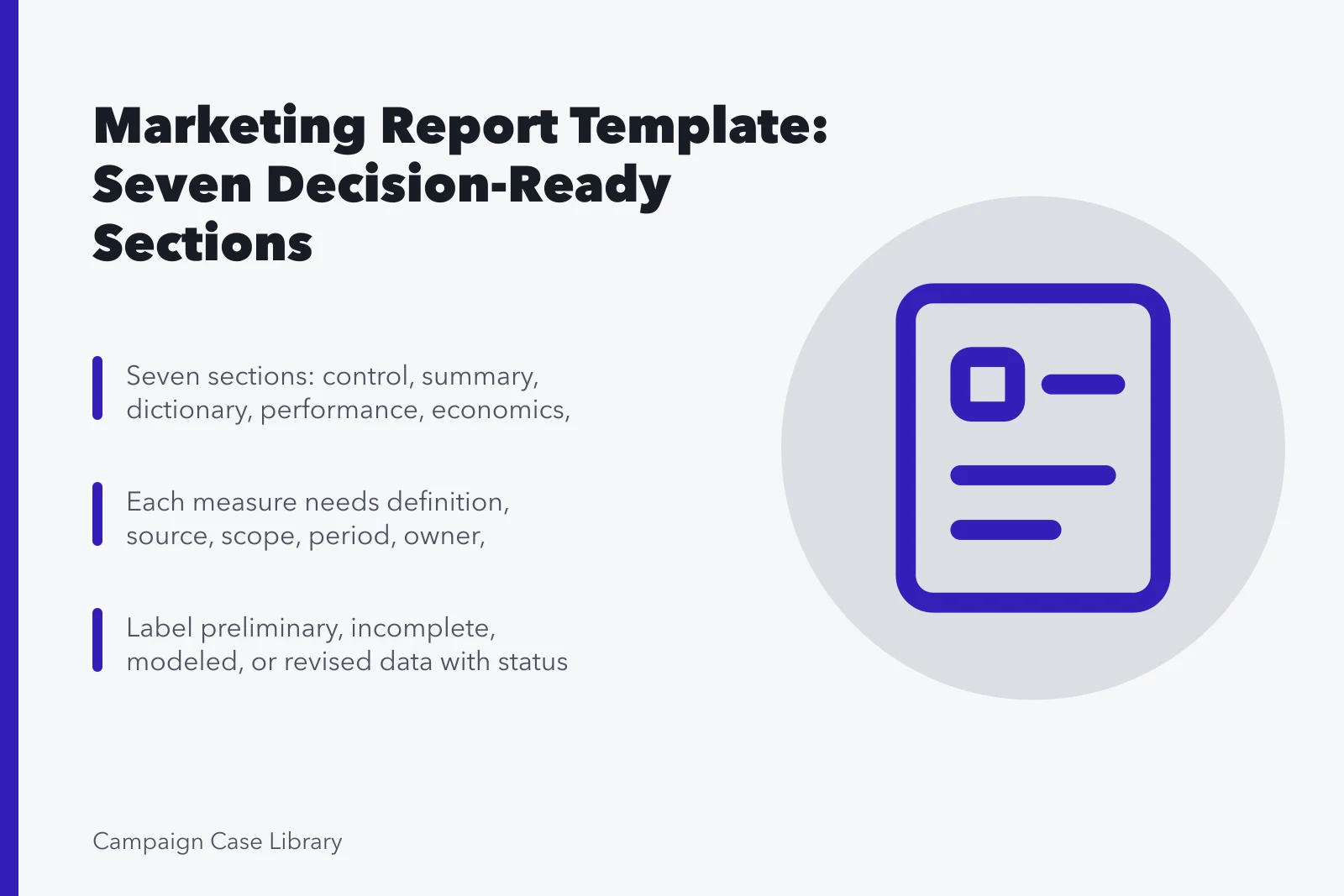
- Seven sections connect report control, executive decisions, metric lineage, objective performance, economics, findings, actions, and documented limitations.
- Every headline measure needs a stable definition, source, scope, period, comparison, freshness status, owner, and traceable quality record.
- Keep one governed evidence layer while changing depth and sequence for the decisions of each authorized audience.
Marketing report template sections should lead from a decision to evidence and action. Use one governed data layer, but change depth for executives, finance, sales, product, operations, and channel teams. Keep definitions stable across views.
Control and purpose
Record report ID, owner, audience, decision, cadence, period, comparison, time zone, currency, data-through time, release status, version, and confidentiality. State which business and marketing objectives the report evaluates.
Executive decision summary
Show objective status, material changes, evidence quality, business implication, decision requested, owner, and due date. Label preliminary, incomplete, modeled, or revised data. Use text with status colors and link to detailed definitions.
Metric dictionary and lineage
Google Analytics' dimensions-and-metrics introduction explains that fields are populated from specific data and that some dimensions and metrics are incompatible. Use that as a platform example, then document definitions, scope, compatibility, transformations, and missing-value behavior for every system in the report.
For every material measure, provide formula, scope, unit, source, field or event, filters, attribution, freshness, revision window, owner, target, and limitation. Add extraction, transformation, join, reconciliation, and quality-check references. The companion piece on how to create marketing report templates covers building that same metric contract and freezing definitions before any chart is drawn.
Performance by objective
The UK Government Analysis Function's evaluation-support page points analysts to the Magenta Book, analytical methods, evaluation competencies, and other government resources. It supports disciplined evaluation planning, not a universal marketing-report model or proof that a reported change was caused by marketing.
For each objective, show target, actual, variance, trend, comparison, segment, driver evidence, and confidence. Separate inputs, delivered outputs, audience response, behavior, impact, and learning so activity is not mistaken for an outcome.
Spend, funnel, and segments
Reconcile planned, committed, invoiced, and platform spend as needed. Define cost, revenue, margin, acquisition, and return calculations. Show funnel counts, conversion, time between stages, cohorts, and only the segments that change a decision.
Findings and actions
Separate observation, possible explanation, evidence, competing explanations, confidence, and next test. List decision, owner, due date, dependency, expected effect, review measure, and status. Carry unresolved actions forward without changing their original date. The equivalent breakdown for marketing proposal template sections follows the same decision-to-safeguard sequence, though a scored proposal must mirror the buyer's order instead.
Limitations and appendices
Disclose data gaps, delay, modeling, attribution, sampling, consent, seasonality, tracking changes, and small groups. Attach detailed channel tables, experiment records, assumptions, change log, accessible data extracts, and reconciliation notes through stable identifiers.
A reader should trace every headline claim to a definition, source, comparison, and action. Drop a section that produces no decision, diagnostic value, or required record. Test the order with an outside reader and change it only when the new sequence makes a decision faster, safer, or easier to audit.
Seven-section acceptance map
| Section group | Required output | Acceptance test |
|---|---|---|
| Control and summary | Audience, period, decision, status | Can the reader act safely? |
| Definitions and objectives | Meaning, lineage, target, variance | Can every number be traced? |
| Economics and findings | Spend, funnel, segments, explanation | Are facts and inference separate? |
| Actions and limits | Owner, due date, uncertainty, appendix | Will learning persist? |
Resolve the question with a decision record
The GAO evaluation design guide connects evaluation questions with evidence needs and design choices. Apply that discipline to marketing report template sections; federal evaluation guidance does not make a local result causal or transferable. A marketing plan template sections guide applies the same evidence discipline to objectives, programs, and measures.
The W3C Privacy Principles statement gives web-system designers shared privacy concepts and warns against shifting privacy work to individuals. Apply it here, then review the governing law and configuration.
Common questions
Must every report use all seven sections?
Cover every relevant decision area, but combine or reorder sections when a defined audience and cadence require a different reading path.
Where should metric definitions appear?
Put short definitions beside material figures and maintain a controlled dictionary with formulas, sources, scopes, owners, changes, and known limits.
What belongs in an appendix?
Store detailed channel tables, experiment records, assumptions, data-quality results, reconciliation notes, extracts, and stable evidence identifiers that would interrupt the main decision path.