
Operations
Part of Building Marketing Proposal Templates That People Actually Use
5 Things to Weigh Up on Marketing Proposal Template Case Study Roundup
A marketing proposal template case study roundup weighs five things: who published the case, what it measured, and whether your own baseline agrees.
What to take away
A marketing proposal template case study roundup is only as good as the five things you weigh before trusting it. The cases below come from PandaDoc customer pages and three named vendor sites checked in September 2026. Every vendor-published figure is a claim, not an audit, and none was independently verified here.
- The two detailed cases are PandaDoc customer stories, not independent evaluations, so treat every figure as a vendor claim.
- BrandStar supports a standardization test; Directive supports a scoping, quoting and approval test.
- Three more named platforms publish customer stories on their own sites: Proposify, Qwilr and Better Proposals.
- Five things decide whether a case transferspublisher, measured metric, baseline, concurrent changes, and your own pilot result.
- The FTC requires a reasonable basis for objective advertising claims before they run, and its review guidance bans hidden incentives and paid rankings.
- Build a local baseline and compare like proposals before you credit a template for the change.
The five things to weigh up
- Who published it.A vendor story about its own product is marketing, not an audit. PandaDoc published the two detailed cases below.
- What it measured.Time saved, review cycles cut and hours to a tailored proposal are process metrics, not win rates.
- The baseline.A 60 percent cut means nothing without the starting number and how it was counted.
- What else changed.Acquisitions, new staff, new pricing and new offers move results alongside any template.
- Your own pilot.Your median author time and correction rate decide whether a template works for you.
Case one: BrandStar and standardization
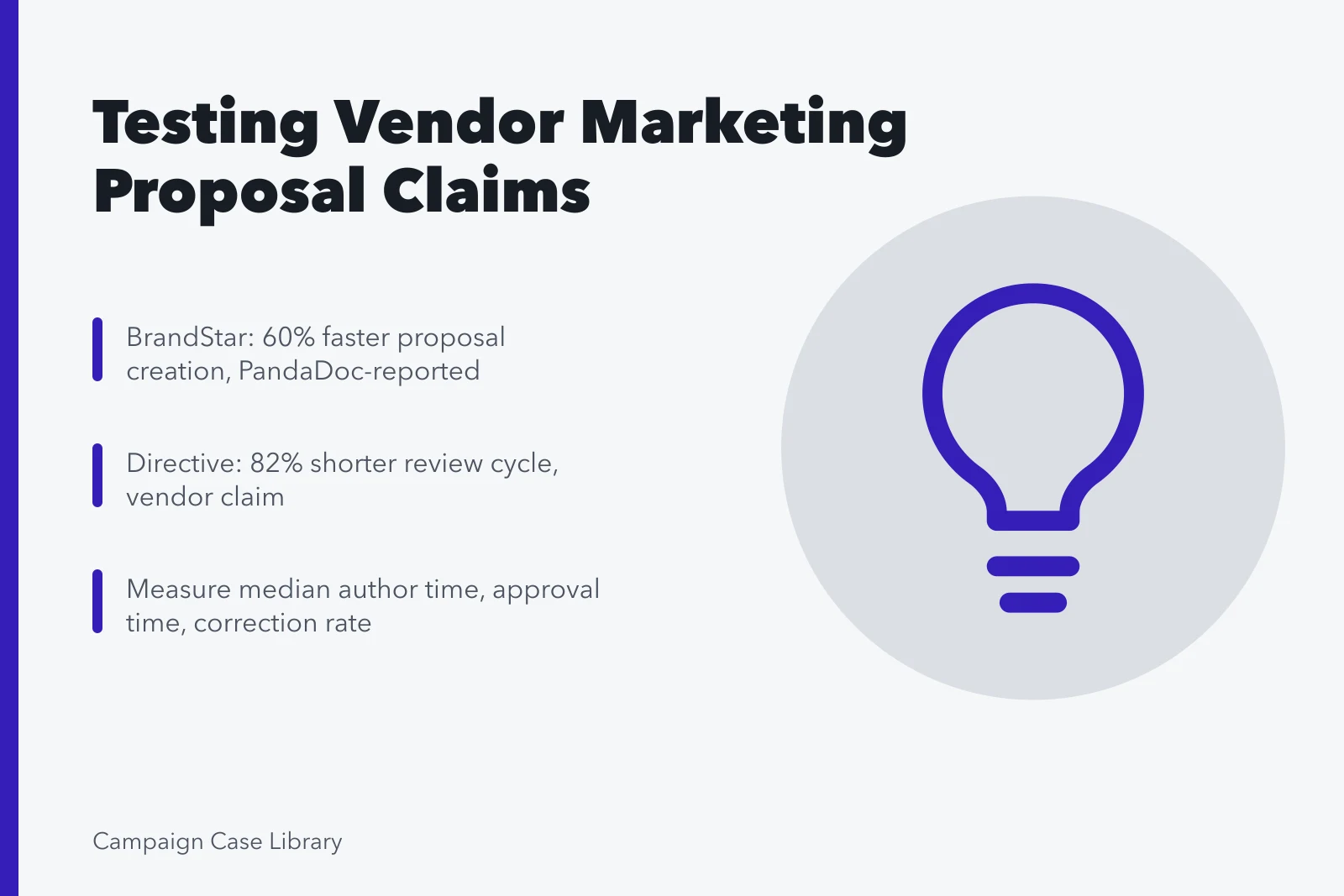
PandaDoc reports that BrandStar, a marketing and production company, cut proposal-creation time by 60 percent after consolidating fragmented tools and standardizing across acquired operations, with HubSpot data feeding document fields.
The transferable lesson is separation. Keep approved company content, service variants, pricing and buyer-specific fields in distinct layers, then measure author time and data errors before and after. A marketing proposal template checklist turns that separation into a pass or fail test before send.
Case two: Directive and approval flow
PandaDoc reports that Directive Consulting, a performance-marketing agency, cut review-cycle time by 82 percent and moved tailored proposals from weeks to as little as 24 hours after changing scoping and quoting.
That points at routing, not design. Ask who supplies scope, who approves price and terms, which content is locked, where exceptions go, and how a late change reaches delivery. The 24-hour figure describes one agency's workflow, not a benchmark you can promise a client.
Cases three to five: Proposify, Qwilr and Better Proposals
PandaDoc, Proposify and Qwilr all price per seat, so a template that saves hours still has to clear the license cost. Those three, plus Better Proposals, publish customer stories without the control group that would settle cause.
Proposify sells proposal software with a shared content library, approval workflow and reusable sections. It suits teams that send similar proposals often. Published plans sit in the $49 to $99 per user per month range as of 2026, and its site stories carry the same vendor-published caveat as PandaDoc's.
Qwilr builds proposals as web pages that track when a buyer opens, scrolls and accepts. It suits teams selling priced options that need acceptance tracking. A free tier exists; paid plans typically run $30 to $50 per user per month.
Better Proposals centers on fixed-price proposals with e-signature and a fast editor. It suits small teams sending one repeatable offer. Plans typically run $25 to $50 per user per month, billed annually.
Baselines are the common gap across all three. Plans and customer stories are public; a before-and-after number with a stated starting point is rarer. Ask the vendor for it, or measure your own.
Design a fair internal test
Pick one proposal type. Track median author time, approval time, correction rate, submission errors and buyer questions. Add content expiry and delivery variance, then compare like proposals over enough observations to see a pattern.
Log every process change running at the same time. Include license, setup, integration, training and review cost in the total. Add archiving. Vendor cases suggest mechanisms; your baseline decides whether a template or platform is working. The same marketing proposal template design tips put the buyer's own evaluation order first.
Five-case transfer test
Five-case transfer test
Vendor case
- BrandStar
- Standardized content, connected fields
- Directive
- Scoping, quoting, approval, exceptions
- Proposify
- Shared content library, approval workflow
- Qwilr
- Web proposal pages, acceptance tracking
- Better Proposals
- Fixed-price offer, e-signature
- Local pilot
- Time, errors, review, delivery variance
Mechanism to test
- BrandStar
- Vendor-reported result
- Directive
- Vendor-reported result
- Proposify
- Vendor-published story, list price
- Qwilr
- Vendor-published story, free tier
- Better Proposals
- Vendor-published story, annual billing
- Local pilot
- Comparable baseline needed
Required boundary
- BrandStar
- Directive
- Proposify
- Qwilr
- Better Proposals
- Local pilot
| Vendor case | Mechanism to test | Required boundary |
|---|---|---|
| BrandStar | Standardized content and connected fields | Vendor-reported result |
| Directive | Scoping, quoting, approval, exceptions | Vendor-reported result |
| Proposify | Shared content library and approval workflow | Vendor-published story, list price range |
| Qwilr | Web proposal pages and acceptance tracking | Vendor-published story, free tier plus paid seats |
| Better Proposals | Fixed-price offer and e-signature | Vendor-published story, annual billing |
| Local pilot | Time, errors, review, delivery variance | Comparable baseline needed |
Audit the published evidence
The FTC advertising substantiation policy requires a reasonable basis before objective advertising claims are disseminated. That is a U.S. standard; for Canadian campaigns, confirm the current rule with the Competition Bureau and a qualified lawyer.
The FTC guidance for marketers using reviews warns about fake feedback, selective requests, conditioned incentives and hidden relationships. Apply those checks whenever a roundup names providers.
Keep the evidence record beside the decision. For a wider set of worked examples, see this template case study roundup so a reviewer can reproduce the reasoning without relying on memory.
Common questions
Do these stories prove PandaDoc caused the results?
No. They are vendor-published customer stories, not independent causal evaluations. Concurrent changes and unpublished context may affect the reported figures.
Why use vendor cases at all?
They identify mechanisms worth testing: standardization, connected fields, scoping, quoting and controlled content. Add approvals and exception routing.
Do Proposify, Qwilr and Better Proposals publish baselines?
Their public pages show plans and customer stories rather than controlled before-and-after data. Ask each vendor for the starting number, or measure your own.
What should a local pilot measure?
Measure median author time, approval time, correction rate, content expiry and pricing errors. Add buyer questions, scope change and delivery variance, plus accessibility defects, total cost and controlled outcomes.
Where does the legal line sit?
The FTC standard applies to U.S. advertising claims. Canadian campaigns fall under the Competition Act, so confirm the current requirement with the Competition Bureau or a qualified lawyer before you publish a performance claim.