Reviews
Part of Building Marketing Proposal Templates That People Actually Use
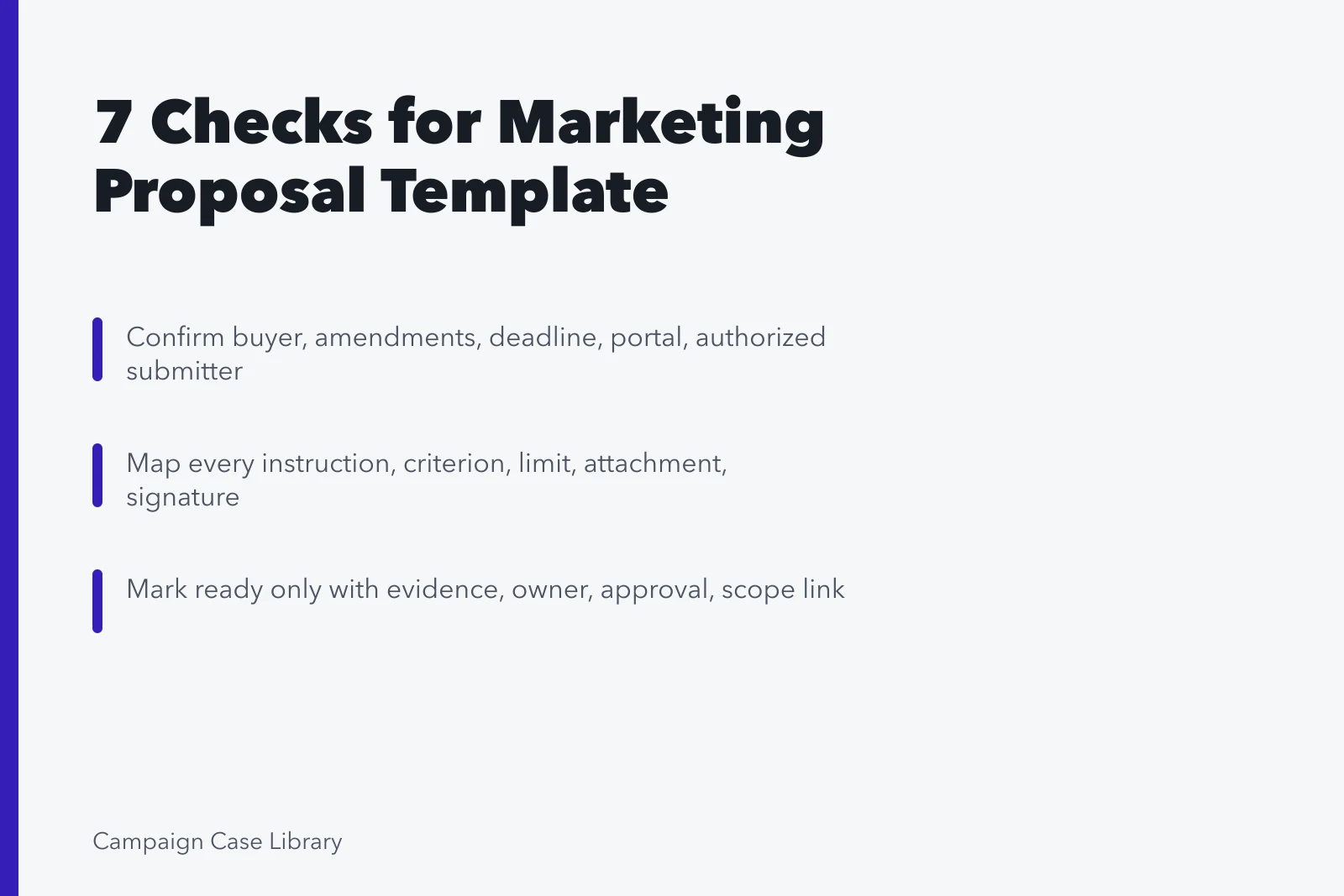
7 Checks for Marketing Proposal Template
marketing proposal template checklist for 2027 tests compliance, buyer facts, solution, scope, delivery, proof, price, safeguards, review, and submission control.
What to take away
- Use the buyer's live instructions and criteria as the controlling checklist for a formal solicitation.
- Mark an item ready only when its evidence, owner, limitation, approval, and relationship to scope, price, schedule, or risk are clear.
- The delivery owner should read the final proposal as a commitment and reject wording the team would renegotiate after selection.
A marketing proposal template checklist tests whether the buyer can evaluate and the seller can deliver what is written. For a formal solicitation, treat the buyer's instructions and criteria as controlling, then adapt it to the market, transaction, and risk.
For 2027, nothing in the seven checks changes; update the source documents, law, and platform rules dated 2027.
The seven checks are:
- Opportunity and complianceconfirm the buyer, opportunity, source documents, amendments, deadline, time zone, portal, authorized submitter, bid decision, capacity, conflicts, and approval owner.
- Buyer and solutionseparate buyer-confirmed facts from seller assumptions and map each workstream to a requirement, outcome, deliverable, owner, timing, acceptance rule, and evidence.
- Scope and deliveryspecify services, markets, audiences, channels, quantities, formats, languages, revisions, source files, inclusions, and exclusions, then reconcile milestones and responsibilities.
- Proof, price, and safeguardscheck every claim against approved evidence, apply the FTC advertising-substantiation policy statement, and reconcile currency, fees, units, media, production, technology, travel, rights, expenses, tax, contingency, options, and payment.
- Review and submissionrun compliance, strategy, delivery, commercial, evidence, specialist, copy, design, and production reviews, and follow FAR 15.208 as federal context for authorized transmission and deadline.
- Checklist disposition recordassign Ready, Conditional, Not ready, or Not applicable, with the required record and next action for each status.
- Privacy and supply-chainuse the W3C Privacy Principles for analytics, tracking, or personal data, and the CISA software acquisition fact sheet for vendor, hosting, and security rows.
Opportunity and compliance
- Confirm buyer, opportunity, source-document versions, amendments, questions, time zone, deadline, portal, and authorized submitter.
- Record the bid decision, delivery capacity, partners, conflicts, contract concerns, evidence gaps, and approval owner.
- Map every instruction, mandatory item, rated criterion, question, limit, attachment, declaration, filename, and signature.
Buyer and solution
- Separate buyer-confirmed facts from seller assumptions, interpretations, and unresolved questions.
- Define desired outcome, baseline, target, time frame, marketing's role, dependencies, and attribution limit.
- Map each workstream to a requirement, outcome, deliverable, owner, timing, acceptance rule, and evidence.
Scope and delivery
These items should trace back to the same seven-part structure covered in marketing proposal template sections, from solution and scope through delivery.
- Specify services, markets, audiences, channels, quantities, formats, languages, revisions, source files, inclusions, and exclusions.
- Reconcile milestones with buyer inputs, approvals, production, accessibility, claims review, localization, launch, and evaluation.
- Name accountable leads, specialists, availability, partners, substitutes, governance, escalation, change control, and buyer responsibilities.
Proof, price, and safeguards
The Federal Trade Commission's advertising-substantiation policy statement explains factors affecting the reasonable basis for U.S. advertising claims, including claim type, consequences, benefit, evidence cost, and expert expectations. Apply qualified review to proposal claims and preserve support before approval.
- Check every capability, experience, performance, saving, reach, speed, and return claim against approved evidence and permission.
- Reconcile currency, fees, units, media, production, technology, travel, rights, expenses, tax, contingency, options, and payment.
- Review assumptions, risks, accessibility, privacy, security, rights, conflicts, regulated claims, obligations, and stop conditions.
Review and submission
The Federal Acquisition Regulation's proposal-submission provision makes offerors responsible for using an authorized transmission method and reaching the designated federal office by the specified time, subject to narrow rules stated there. Treat it as federal context and follow the buyer's actual submission terms.
- Run compliance, strategy, delivery, commercial, evidence, specialist, copy, design, and production reviews with named decisions.
- Score the near-final response against the published criteria and fix contradictions across narrative, schedule, price, team, and attachments.
- Validate links, document properties, accessibility, file names, size, signatures, receipt, and the exact archived submission package.
These formatting checks follow the same accessible-structure rules as marketing proposal template design tips: real heading styles, sufficient contrast, and a logical reading order.
If the delivery owner would renegotiate scope, timing, staffing, assumptions, or acceptance after award, the proposal is not ready. Repeat this check after every material buyer amendment.
Checklist disposition record
Use Ready when evidence, owner, approval, and trace are in place. Use Conditional when a gap has an interim limit and a deadline. Use Not ready for a material contradiction or omission. Use Not applicable when the item does not apply and an approver accepts the reason.
| Status | Required record | Next action |
|---|---|---|
| Ready | Evidence, owner, approval, trace | Release with version |
| Conditional | Gap, interim limit, deadline | Assign and monitor |
| Not ready | Material contradiction or omission | Stop or correct |
| Not applicable | Reason and approver | Recheck after amendment |
Example: an accessibility item starts as conditional because the audit date is missing. The owner records the gap, sets an interim limit, names a deadline, and obtains approval. The item moves to ready and releases with version 1.3.
Privacy and supply-chain checks
Two external sources feed specific checklist items. The W3C Privacy Principles statement gives web-system designers shared privacy concepts and warns against shifting privacy work to individuals. Use it when a proposal touches analytics, tracking, or personal data, and record the governing law and configuration for that item.
The CISA software acquisition fact sheet covers development practice, supply-chain exposure, deployment, and vulnerability management. Use it for the vendor, hosting, and security rows, then add those government-acquisition questions to a marketing proposal template checklist review without treating them as local approval.
Common questions
Should every checklist item be mandatory?
No. The buyer's requirements are controlling. Mark other genuinely irrelevant items not applicable, record why, and identify who accepted that scope decision.
What if evidence is incomplete?
State the gap, limitation, owner, deadline, interim wording, and decision affected. Remove or qualify the claim when adequate support is not approved.
Who gives final approval?
Use the person authorized to approve the proposal, supported by delivery, finance, evidence, accessibility, privacy, security, rights, claims, legal, and procurement reviewers where applicable.