Careers
Part of Marketing Plan Templates: Structure, Wording and the Parts to Adapt
The Marketing Plan Template Trends That Will Still Matter Next Year, Updated for 2027
marketing plan template trends for 2027 include guided drafting, modular files, decision histories, evidence fields, accessible exports, and data minimization.
What to take away
- Treat every 2027 trend as a design hypothesis that must survive a real planning cycle and current policy review.
- Modular files and living histories increase the need for stable identifiers, authoritative sources, approvals, retention, and exports.
- Accessibility and data minimization belong in the reusable master and workflow, not a repair after information has spread.
Marketing plan template trends for 2027 are design signals, not predictions that every team should follow. Test each change against users, decisions, risk, systems, and local obligations.
Guided planning reduces blank-page friction
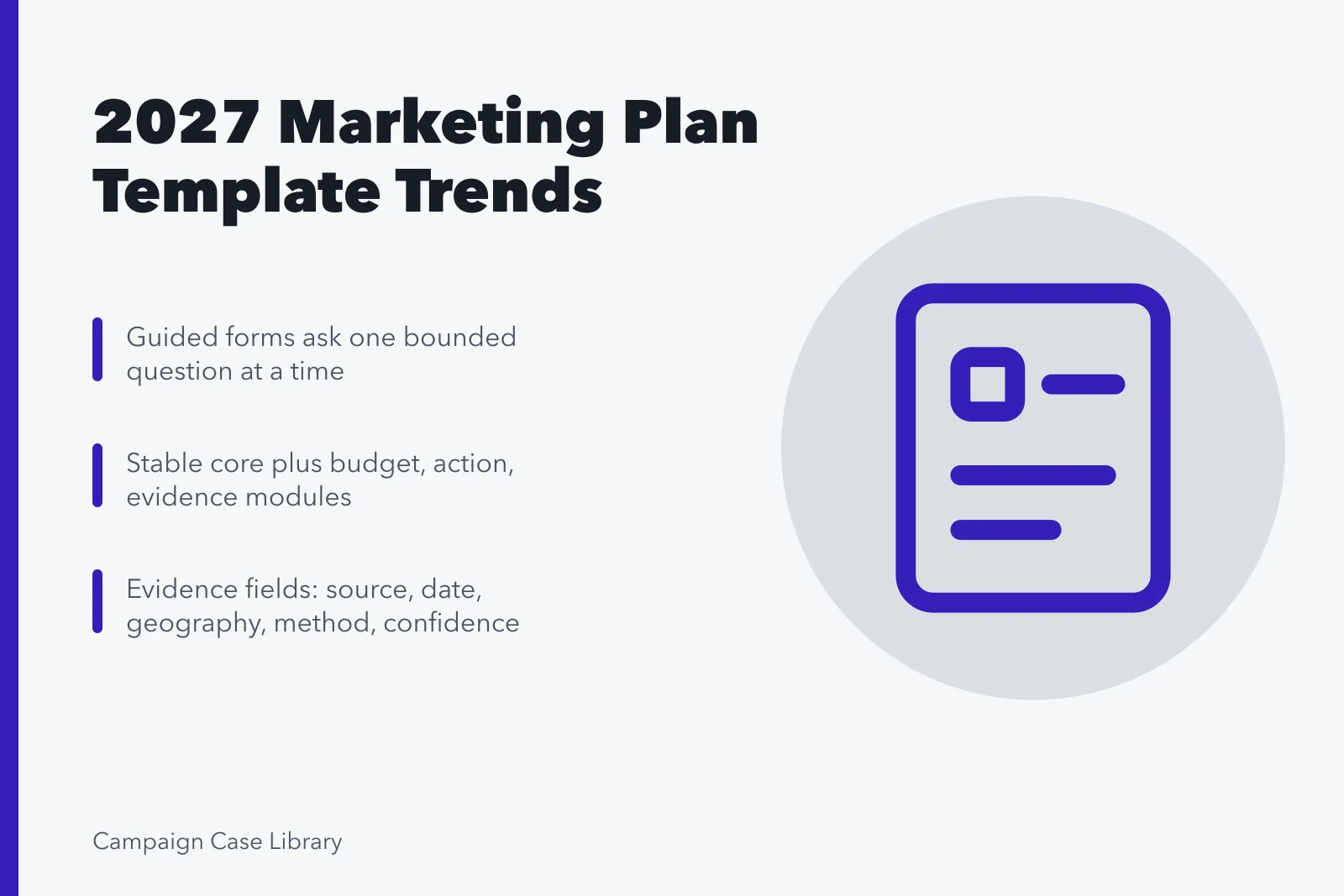
Guided forms can reduce blank-page friction by asking one bounded question at a time and producing a structured first draft. In 2027, teams should still require customized evidence, explicit uncertainty, qualified review, and an accountable owner.
Guided Drafting Controls
- Ask one bounded question
- Produce structured first draft
- Require customized evidence
- State explicit uncertainty
- Get qualified review
- Name accountable owner
One file becomes a modular plan system
A reasonable 2027 direction is a stable core plus controlled budget, action, evidence, measurement, and local modules. Modular files can improve usability, provided owners, identifiers, versions, access, and authoritative sources are clear. The benefit should be tested rather than assumed from a smaller main document.
Plans become living decision records
Collaborative histories make earlier edits easier to inspect, but behavior depends on permissions, product limits, retention, and deletion. Version history behaves differently in each product, as the marketing plan template tools comparison sets out. Teams should name review versions, preserve approved independent snapshots, and record why priorities changed. A platform history does not replace explicit approval and records policy.
Evidence fields become standard
Templates will ask for source, date, geography, definition, method, assumption, confidence, and limitation beside claims and targets. It helps teams distinguish observed facts, calculations, modeled targets, and hypotheses.
Accessibility moves into the master
Section508.gov's common PDF tags guide describes document, heading, link, figure, caption, formula, and table tags as structural foundations of an accessible PDF. Use the current applicable standard and inspect the converted file because source appearance alone does not prove that structure survived export.
In 2027, design structured headings, accessible links, useful alt text, simple tables, and checks into the source template. Add representative testing into the source template, and validate every export each time.
A visually attractive PDF is not enough if tags, relationships, alternatives, navigation, reading order are lost. The same marketing plan template design tips keep the source document readable first.
Data minimization shapes collaboration
The Federal Trade Commission's Start with Security guide advises businesses to build security into decisions, avoid collecting information they do not need, limit retention to a legitimate need, and restrict access. The guide draws lessons from U.S. enforcement matters, so apply current jurisdiction-specific law and qualified advice.
Planning templates benefit from aggregated evidence, controlled references, limited permissions, and defined retention and deletion. Collaborative convenience does not justify copying customer or employee records into every plan. Treat reduced collection as a design constraint and verify the actual legal and operational requirements.
The practical response
Keep a compact, accessible core; add conditional modules; maintain an evidence index and decision log; name approved versions; and minimize sensitive data. Pilot changes during one real planning cycle. The best 2027 template will be the one a team can understand, govern, update, and use to make a better decision.
2027 trend decision record
| Signal | Required control | Stop condition |
|---|---|---|
| Guided drafting | Evidence and human approval | Prompts create false certainty |
| Modular files | Identifiers and authority | Totals or versions diverge |
| Living history | Snapshot and retention | Approval cannot be reconstructed |
| Accessible export | Structure and user testing | Reading order or access fails |
Maintain a dated watchlist
The NIST AI RMF Playbook offers voluntary AI-risk actions under govern, map, measure, and manage. Use them when AI changes marketing plan template trends; the playbook is not a product ranking or forecast.
The W3C Privacy Principles statement gives web-system designers shared privacy concepts and warns against shifting privacy work to individuals. Apply it here, then review the governing law and configuration.
Common questions
Which 2027 template trend matters most?
The useful trend is the one that fixes a measured planning problem without weakening evidence, accessibility, privacy, security, approval, or records control.
Should teams use guided template tools?
Test them for prompt quality, privacy, session behavior, export, accessibility, customization, ownership, and ongoing governance before entering sensitive information.
Does version history make approved snapshots unnecessary?
No. Permissions, merging, deletion, retention, and product changes can affect history. Preserve an explicit approved record under the organization's policy.