Rules
The purchasing section of a zero proof case study reveals more than price
What the purchasing section of a hospitality case study should show, the decisions that get skipped, and how to verify a supplier claim yourself.
The purchasing section is usually the weakest part of a hospitality case study. It lists what was bought and skips why, which is the only part a reader can learn from. A useful version records the alternatives considered and the constraint that decided between them.
What to take away
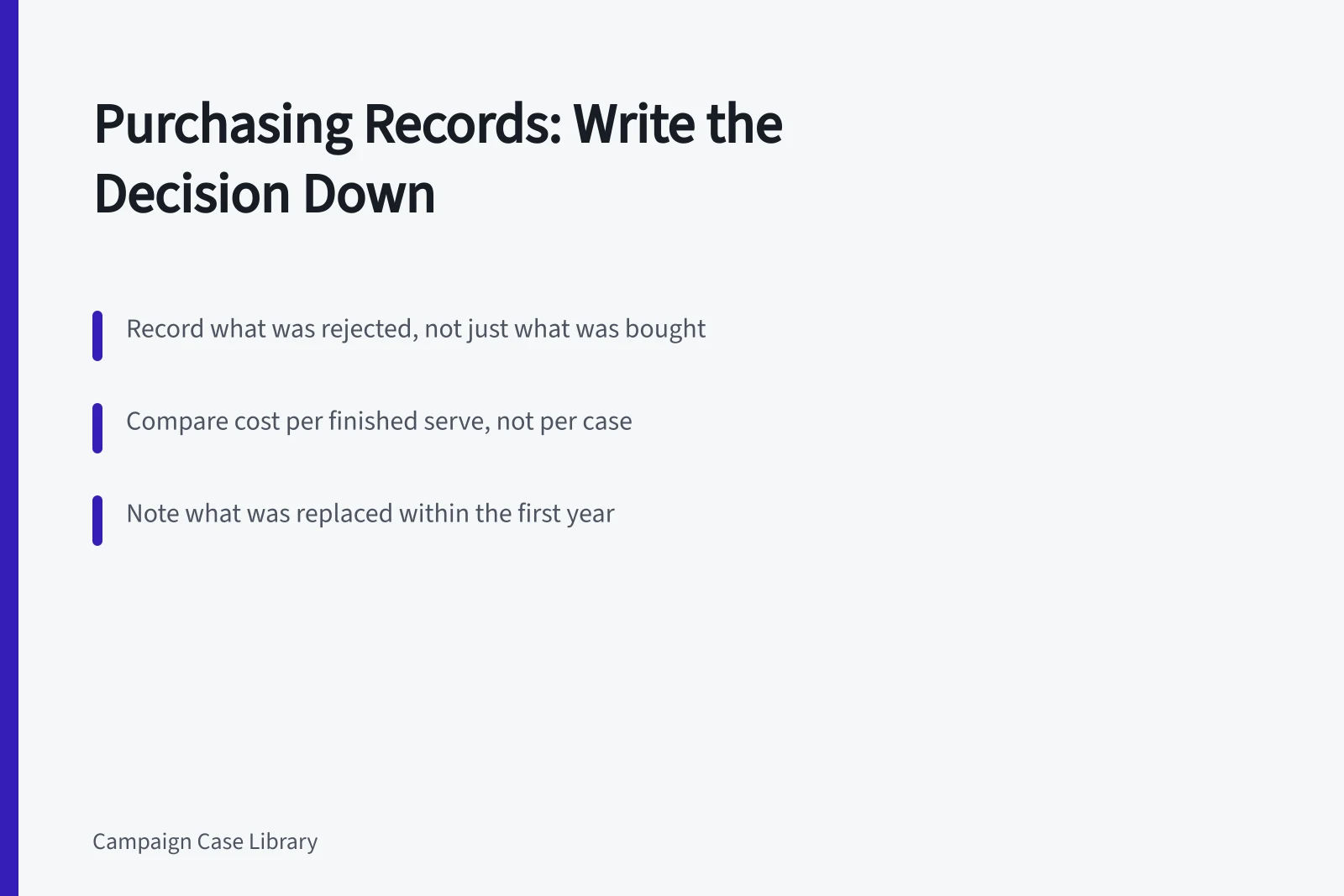
- Record the decision, not the purchase. What was rejected explains more than what was chosen.
- Constraints, not preferences, drive most equipment and stock decisions.
- Supplier claims can be verified independently, and a case study should say whether they were.
- Food handling training is a purchase too, and it is usually invisible in the figures.
What a purchasing section should contain
- The constraint that framed the decision, such as space, power, delivery frequency or storage.
- The options considered, including the one that was too expensive.
- The unit of comparison used, for example cost per finished serve rather than cost per case.
- What was bought used or borrowed rather than new.
- What was replaced within the first year, and why.
That last line is the most informative and the most frequently absent. Early replacements identify the decisions that were wrong, which is what a reader is actually looking for. Which parts wear out and should have been ordered as spares is set out in our checklist for a bar tool kit.
Purchasing section essentials
- Constraintspace, power, delivery, storage
- Options considered, including too expensive
- Unit of comparisoncost per serve
- What was bought used or borrowed
- What was replaced within first year
Verify the supplier claim yourself
A case study that repeats a supplier's description without checking it has recorded a marketing sentence. Verification is often straightforward.
Verify supplier claims
- AlcoholTTB mandatory label checklist
- Check bottle against TTB list
- Foodingredient list
- Foodallergen statement
- Foodresponsibility line
For alcohol beverage products, TTB publishes the checklist of mandatory label information for malt beverages, the list of items reviewed on every label and certificate of label approval application, published so that applicants can avoid the most common errors. A buyer can work through the same checklist against a bottle in front of them.
For products regulated as food, the equivalent exercise is the ingredient list, the allergen statement and the responsibility line. Neither takes long, and either is more informative than a supplier deck.
Training is part of what gets bought
Each new product or piece of equipment means handling someone must be taught. FDA's guidance on safe food handling says why that training belongs in the budget, not a footnote.
The federal government estimates 48 million foodborne illness cases a year, about one in six Americans, with 128,000 hospitalizations and 3,000 deaths.
The same guidance notes that illness usually appears within one to three days of eating contaminated food, though it can appear within 20 minutes or up to six weeks later. That delay is why a case study rarely connects an outbreak to a purchasing decision, and why the training line deserves to be recorded even when nothing went wrong.
Write it while you remember
Purchasing rationales evaporate within weeks. The practical method is a single line written at the moment of the decision: what we bought, what we did not, and why. A year later that file is the case study.
This is also the cheapest protection against repeating a decision. Operators frequently rebuy an item that failed the first time, because the failure was remembered as bad luck rather than as a known limitation.
A dated line saying we chose this despite the narrow neck, and regretted it, prevents the second purchase without anyone having to remember anything. Buying a setup rather than a drawer of single items is the other half of that, which our notes on five bar tool setups cover.
Reading the figures around these decisions is covered in our guide to case study budgets, and the mistakes buyers repeat are set out in trade buying mistakes.