Rules
Portfolio case studies failures beyond the obvious
Portfolio case studies failures: eight ways a write-up goes wrong, from name collisions to unrecorded transfers, and the self-check that catches them.
The failures worth studying in celebrity ventures are not the ventures. They are the write-ups: pieces of research that looked sound, were published, and turned out to be about the wrong company, the wrong date, or a connection that was never there.
This page collects those failure modes. Each one has been produced by careful people working from real records, which is the point: the records themselves invite most of these errors. No study, publication or person is named.
This site follows celebrity businesses and investments. In that subject, a well-known name can appear near several entities, and the failure modes below are how a reader gets sent to the wrong one. The same record discipline applies. The difference is that here the famous name is often the thing doing the misleading.
What to take away
- The commonest fatal error is a name collision, and it is invisible unless you look for it on purpose.
- The second commonest is treating a register as current when it is a snapshot of what was last filed.
- An unrecorded transfer means the register is correct and out of date at the same time, and nothing flags it.
Eight ways a case study goes wrong
| Failure | What it looks like | How to catch it |
|---|---|---|
| Name collision | Two unrelated entities with the same or similar name | Compare jurisdiction, formation date and agent before merging anything |
| Person collision | A common name appearing on unrelated filings | Never connect people by name alone |
| Stale status | A register entry that reflects the last filing, not today | Record the date you checked, and check again before publishing |
| Unrecorded transfer | The register names an owner who sold years ago | Treat ownership of record as a claim about the record |
| Dissolved but trading | An entity in bad standing whose business continues | Check for a successor entity formed nearby in time |
| Press release recycling | Several outlets repeating one announcement | Trace every version back to its earliest source |
| Inference creep | A dotted line hardening into a solid one across drafts | Re-read the final text against the evidence log, not the previous draft |
| Class confusion | Marks in different classes read as one brand | Compare class numbers, not names |
The two that do the most damage
The collision. Registers index by name, and names repeat. Two companies with the same trading name in different states are usually unrelated, and two people with the same name are almost always unrelated. A study that merges either has produced a fictional entity or made a claim about someone who has nothing to do with the subject. The portfolio case studies portfolio page sets out the rule that follows: connect entities by filings, never by coincidence.
Record vs Reality
What the record shows
- Same name in two states
- Entities are related
- Same name on two filings
- People are the same person
- Former owner on register
- No sale happened
- Status as of last filing
- Current status today
What it does not prove
- Same name in two states
- Same name on two filings
- Former owner on register
- Status as of last filing
The unrecorded transfer. A mark can change hands without the assignment being recorded promptly. The statutory assignment provision provides for recording and gives a reason to do it, but recording is a step that has to be taken, and it lags. So a search showing a former owner is not evidence that no sale happened. It is evidence about the record.
The same applies to entity status. State filings are periodic, and the obligations behind them are described in the guide to registering a business. What you are reading is the last thing filed, which may be eleven months old.
Why endings are the most dangerous section to write
A study that reaches an ending wants to explain it, and explanation in this category almost always means naming a decision. The record does not contain decisions. It contains status changes with dates.
Writing an Ending
Does the record contain a decision?
Name the decision and its source
Give dates plus what is not knowable
Buyers spend months on due diligence because the material explaining a business is private and must be handed over. An outside researcher has none of it. A published sentence attributing an ending to someone's judgment is a reconstruction presented as a finding.
The celebrity companies failures page sets out what can honestly be said instead: a sequence of dates plus an explicit statement of what is not knowable.
The maintenance failure
A case study is a dated artifact. Statuses change, assignments get recorded, marks lapse, and entities are formed to replace others. A study that was accurate when published becomes wrong without anyone touching it.
- Keep the evidence log with the piece, including searches that found nothing.
- Record the date of every check inside the text, not only in a footer.
- Recheck before any reuse, and at least annually.
- When something changes, correct the piece and keep a note of what it said before.
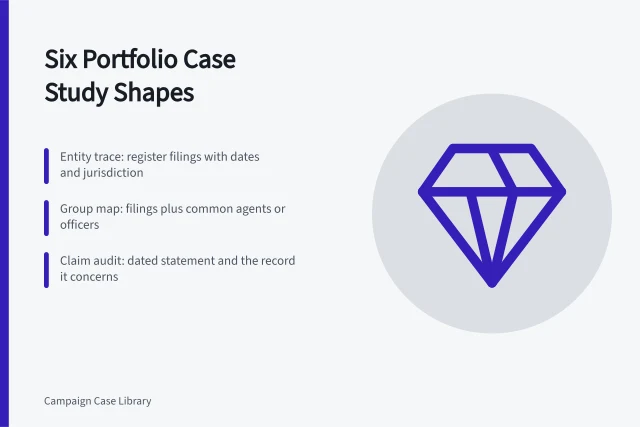
The portfolio case studies list page describes the study shapes this discipline applies to, and the portfolio case studies by industry page sets out which records exist to recheck in each sector.
The self-check before publishing
- For every factual sentence, name the record that supports it.
- For every sentence you cannot do that for, either cut it or mark it as inference in the text.
- Search for name collisions on every entity and person mentioned.
- Confirm each record's date and write it in.
- Read the piece as though you were the subject's lawyer, and see which sentence you would attack first.
- Fix that sentence.
Step five is the useful one, and it is uncomfortable by design. The portfolio case studies page sets out the evidence ladder that step one is really testing against.
Common questions
Is it acceptable to publish an inference?
Yes, labeled as one, in the text rather than in a note. What is not acceptable is an inference written in the same voice as a record.
What if a subject disputes a finding?
Check the record again first. Where the record supports you, say so and keep the piece. Where it does not, correct it visibly and keep the correction attached.
How much of this applies to a short piece?
All of it. A short piece has fewer sentences to check, not a lower standard.
Does using several sources make a claim safer?
Only if they are independent. Three outlets repeating one announcement are one source with three bylines.